



Key takeaways
6%
describe their field data as high quality and actively used in analytics and AI
56%
say their data is adequate but inconsistently captured
73%
have yet to deploy effective agentic AI, including 41% who call theirs outright ineffective
8%
rate agentic AI for autonomous triage and next-best-action as very effective
55%
rate predictive maintenance alerts delivered via mobile as very effective
Source: Managing a Mobile Workforce 2026 report, TrueContext and Field Service Next. Survey of 100 field service organizations.
There is one number in the latest Field Service Next Insights research that should have every field service leader thinking twice about their AI transformation projects. Across 100 organizations surveyed, only 6% describe their field data as high quality and actively used in analytics and AI. Six percent, barely a blip. That's the totality of how ready businesses are to adopt and leverage AI in service of their goals.
The gap between ambition and foundation
Field service organizations are not short on AI ambition. Most respondents plan to increase mobile technology spending over the next 12 months. The industry as a whole sees agentic AI as the next major frontier in field service automation. The problem? Those ambitions are not built on anything solid.
Consider how leaders actually describe the data they collect. Only 6% call it high quality and analytics-ready. More than half, 56%, say their data is adequate but inconsistently captured, limiting how useful it can be. Another 29% say their data is fragmented across systems and hard to consolidate, and almost one in 10 call it largely incomplete or unreliable. Put these pieces together and the puzzle becomes a picture of concern. The overwhelming majority of field service organizations are sitting on data they cannot fully trust, resctricting the true potential of any intelligence-driven initiative that happens downstream.
That foundation shows up directly in AI results. 73% of respondents have yet to deploy effective agentic AI, including 41% who say theirs is outright ineffective. When rated capability by capability, agentic AI for autonomous triage and next-best-action lands at just 8% very effective, while 32% aren't using it at all. Ironically, nearly three-quarters of organizations are getting no meaningful value from the tool many of them consider most important to their future.
Why some field AI services work, and others don't
The contrast inside the report is instructive. The good news is, not all AI projects are failing. Predictive maintenance alerts delivered via mobile are rated very effective by 55% of respondents. Generative AI for knowledge base access and repair guidance performs well too, with 37% calling it very effective and another 51% somewhat effective.
Yet, it's important to note that success is not random. The AI capabilities that work are the ones running on narrower, more structured, more reliable data streams. Predictive maintenance draws on sensor and asset signals. Generative repair guidance draws on documented knowledge bases built using a combination of manufacturer literature and years of experience with assets. On the other hand, the capabilities that fail are the ones that depend on rich, connected, high-quality field data captured across the whole operation, which is exactly the data that 94% of organizations admit they do not have.
Agentic AI promises to execute tasks accurately, at speed, with minimal human intervention. But an agent can only act as well as the data it reads. As the research puts it, the fact that so few respondents see value from agentic AI is reflective of the state of field data itself.
The record of outcomes, not reasoning
There is a subtler reason the data isn't ready, and it goes beyond than syncing or integration. Most field organizations believe they solved their data problem years ago when they digitized. They can point to a decade of work order history, completion records, parts usage, and resolution codes, all of it searchable. What they have, however, is a record of outcomes. What they are missing is judgment.
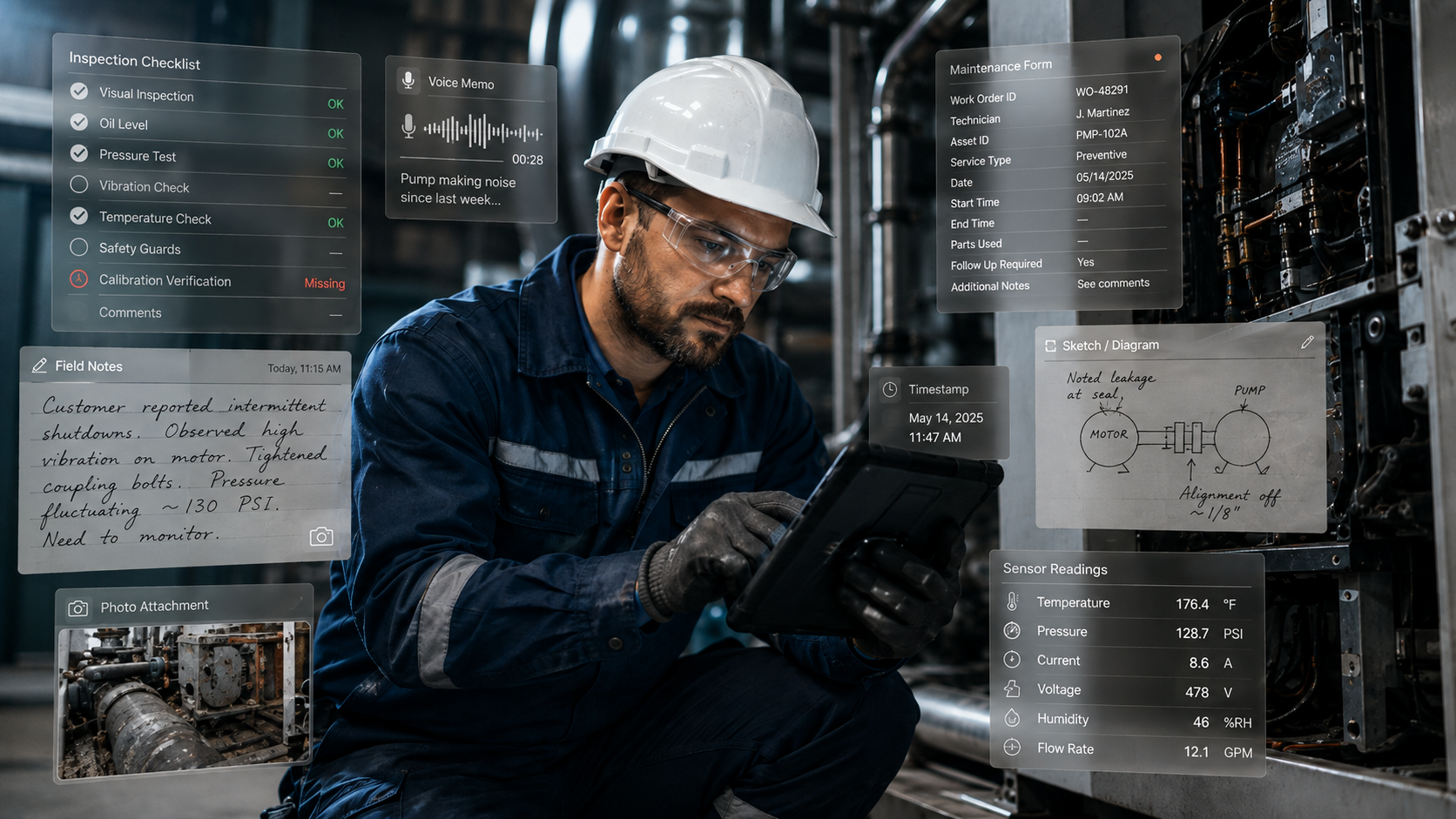
Take a typical work order: "replaced valve assembly, 90 minutes, closed." Behind those words, a veteran technician heard something wrong in the first two minutes, skipped the diagnostic sequence the manual prescribes because they already knew where it led, checked three things that appear on no checklist, and ruled out two likely causes before touching the valve. Ninety minutes of expert reasoning, and the system kept eleven words of it, typed from a truck at the end of a shift into a form designed for an auditor.
Give an AI model ten years of records like that and it learns, faithfully, to reproduce outcomes. It can tell a newer technician what got replaced on similar jobs. It cannot tell them what the expert ruled out, or why, because that reasoning was never captured. Swap in a more powerful model and you get a more of the same results, just delivered more fluently.
This matters more every year. Roughly 20 to 25% of skilled trades workers in North America are over the age of 55. The judgment that lives in those workers is walking toward the exit, and most organizations are capturing the outcomes it produces while losing the reasoning behind them.
Data infrastructure before AI expansion
The barriers respondents name point to the same conclusion. 63% say siloed field data that isn't connected to enterprise systems is the top barrier to extracting strategic value. 53% say their platform captures data but doesn't generate insights from it. 46% lack the analytics tools to turn field data into action. Taken together, these describe organizations sitting on data they can't use, running tools that don't talk to each other, and missing the layer that would make the data actionable.
The AI solutions you build today are only as good as the data you feed into them. For leaders planning AI investment, that reframes where the first move should be made. The question is not which model to buy. It is how to capture the right knowledge, structured and reliable, so that it's coherent enough for any AI model to be able to make sense of.
What "ready" actually looks like
Building a field data layer that AI can actually learn from comes down to a few principles that any organization can start applying now.
Capture at the moment of decision, not the end of the day
Reasoning is perishable. Anything that waits for the end of a shift collects a summary, and the summary is precisely where the logical chain gets dropped.
Structure the judgment, not just the result
Ask what the technician ruled out and why. Those answers are recoverable in seconds when the workflow asks well, and lost forever when it doesn’t.
Subtract keystrokes before you add any
Ask technicians to document more and they document less. Every field you add has to be paid for by removing friction elsewhere.
Return value inside the same workflow
A technician who sees the system give something back will feed it. One who feels audited will give the minimum.
