


Product

Solutions

Why TrueContext

Pricing

Resources

close

Product

Solutions

Why TrueContext

Pricing

Resources

west

MOST COMMONLY USED FOR

Installation

More assets in less time with guided workflows

Maintenance & Repair

Improve asset uptime with predictive maintenance

Inspections & Compliance

Optimize your operational excellence

Environment, Health & Safety

Protect workers, the public, and the environment

INDUSTRIES WE SERVE

Industrial Equipment

Power asset performance and human safety

Medical Equipment

Precision for sophisticated instrumentation

Oil & Gas

Operational excellence across the energy stream

Field Service

Break new ground in productivity, quality, and safety

Use Case Spotlight

west

THE TRUECONTEXT ADVANTAGE

Field Intelligence

Collect, Analyze, Optimize

Operational Intelligence

Rich, Insightful, Predictive

Augmented Technicians

Connected, Informed, Amplified

Connected Worker

Smarter, Safer, AI-Augmented

Operational Agility

Intelligent, Accelerated, Efficient

MAKING THE SWITCH

Internal Development vs. TrueContext

A Strategic Comparison

Rapid Migration

From paper or legacy systems

Deployment Services

Dedicated expertise, enhanced support

Resource Spotlight

west

EXPLORE

Customer Stories

TrueContext applied in enterprise environments

Webinar & Events

Explore emerging trends with us at upcoming events

Blog

Stories and insights from the field

LEARN

Knowledge Base

Answers to the most common product questions

Product Documentation

TrueContext features, usage, and technical details

TrueContext University

Hands-on training to optimize your deployment

Resource Library

Content for your industry and application

CONNECT

Community

Collaborate with industry peers

Contact Support

Having trouble? Ask our product support team

Talk to Sales

See how TrueContext can help your business

Become a Partner

Join our growing partner network

Ebook

The intelligent future of field service

The Definitive Guide to Field Intelligence Part 8

Where field intelligence goes from here

For two decades, field service technology has been very good at one thing: automation. Paper moved to screens, jobs were routed to the right technician, and data moved downstream without anyone re-keying it. That was real progress. The next leap is toward cognition.

Field service beyond automation

An automated workflow executes a task without knowing what the task means. It records that a reading was 4.2 and passes it on, with no opinion on whether 4.2 is normal.

Field intelligence is what lets the operation know. With a structured history behind it, the same reading carries meaning — even prediction. A reading of 4.2 runs high for this asset model, sits within the normal range for this climate, and matches what this asset showed in the eight weeks before its last failure.

Automated workflow 4.2 Recorded and passed downstream. No standardized view on whether it is normal. That judgment rests on the individual technician.
With field intelligence 4.2
  • HighFor this asset model
  • NormalFor this climate
  • PatternMatches the eight weeks before its last failure

The number is identical. What the operation can do with it is not.

From systems that process the work to systems that reason about it

That’s where field intelligence is taking service operations.

From recording to advising. Instead of storing a finding, the system flags the potential failure that the finding points to. It also suggests the part that a specific model typically needs when it starts exhibiting specific symptoms and routes the job to the technician who’s historically strongest on this type of work.

From fixed scripts to responsive workflows. A workflow written in advance assumes conditions will hold, and in the field they rarely do. Thresholds stop being numbers set once in an office and become ranges informed by what the whole fleet is showing. The workflow branches, escalates, or simplifies based on the situation in front of the technician, instead of the conditions the template imagined.

From individual judgment to shared judgment. Reasoning is the connective tissue that explains the why of all field activity. Capturing this, too, beyond the usual outcome findings, allows you to scale judgment that used to belong to a few experienced technicians to the entire operation, without the skills being distorted as they travel through your workforce.
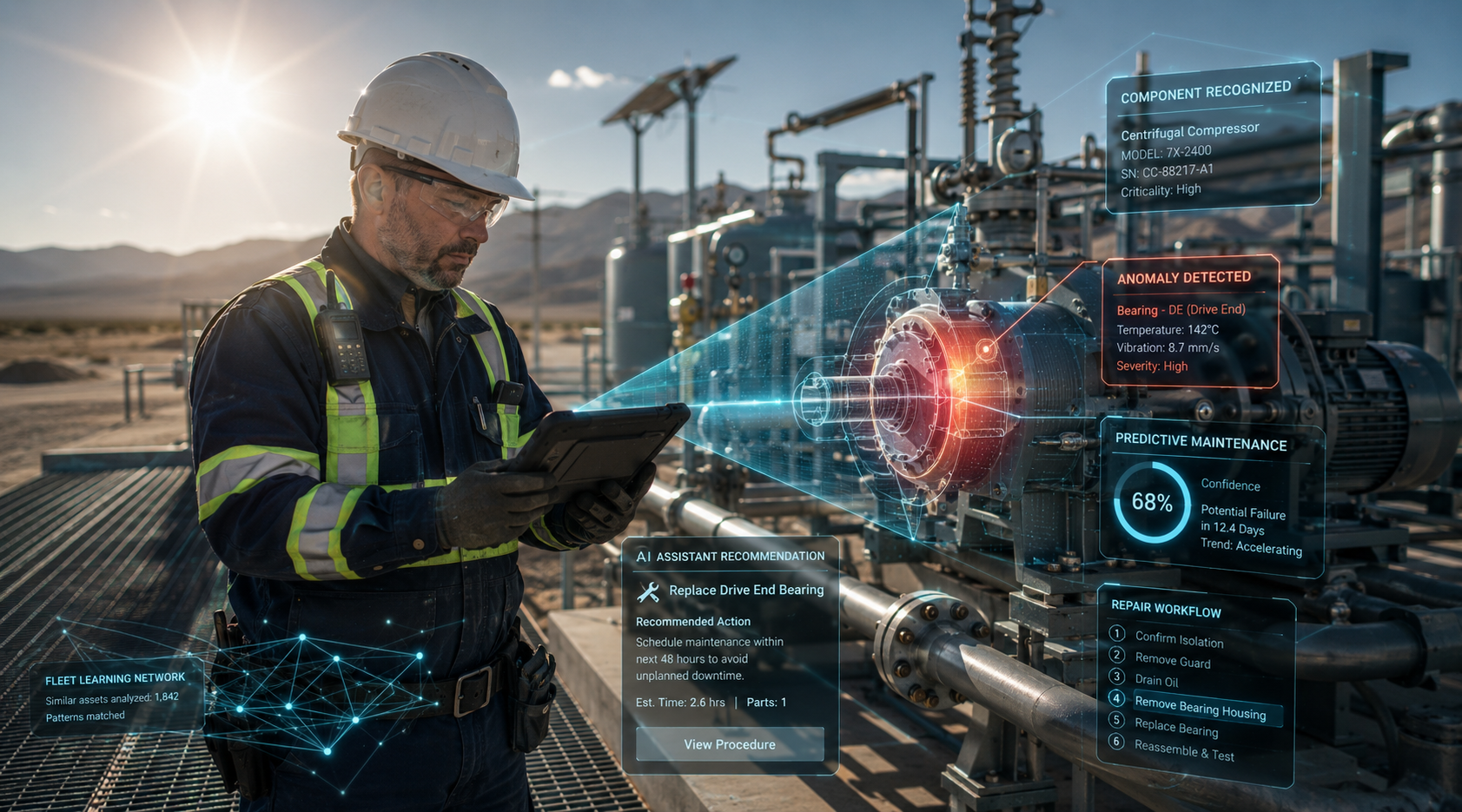
Technician at a compressor station with on-screen AI guidance: component recognized, anomaly detected, predictive maintenance, and a repair workflow

AI goes only as far as the field record allows

AI will accelerate each of these shifts, but the leap you make is only as big as the record allows. Operations that build that record now will have systems that can reason about the realities that the data represents. The rest will have systems that describe the past fluently while understanding nothing about why it happened.

From organization to learning organism

This is where the move from organization to learning organism leads. An organization processes its work. A learning organism senses what is happening, understands what it means, and changes how it acts, on every job and at every level, with a consistency no single person could sustain.

In the past, automation kept service operations running.
Today, field intelligence enables them to learn.

Build the record your operation learns from.

See how TrueContext captures structured data at the point of work, surfaces what it means, and puts it back in the hands of every technician on the next job.

The Definitive Guide to Field Intelligence

Part 8

Where field intelligence goes from here

For two decades, field service technology has been very good at one thing: automation. Paper moved to screens, jobs were routed to the right technician, and data moved downstream without anyone re-keying it. That was real progress. The next leap is toward cognition.

Field service beyond automation

An automated workflow executes a task without knowing what the task means. It records that a reading was 4.2 and passes it on, with no opinion on whether 4.2 is normal.

Field intelligence is what lets the operation know. With a structured history behind it, the same reading carries meaning — even prediction. A reading of 4.2 runs high for this asset model, sits within the normal range for this climate, and matches what this asset showed in the eight weeks before its last failure.

Automated workflow
4.2
Recorded and passed downstream. No standardized view on whether it is normal. That judgment rests on the individual technician.
With field intelligence
4.2

  • HighFor this asset model
  • NormalFor this climate
  • PatternMatches the eight weeks before its last failure

The number is identical. What the operation can do with it is not.

From systems that process the work to systems that reason about it

That's where field intelligence is taking service operations.

From recording to advising. Instead of storing a finding, the system flags the potential failure that the finding points to. It also suggests the part that a specific model typically needs when it starts exhibiting specific symptoms and routes the job to the technician who's historically strongest on this type of work.

From fixed scripts to responsive workflows. A workflow written in advance assumes conditions will hold, and in the field they rarely do. Thresholds stop being numbers set once in an office and become ranges informed by what the whole fleet is showing. The workflow branches, escalates, or simplifies based on the situation in front of the technician, instead of the conditions the template imagined.

From individual judgment to shared judgment. Reasoning is the connective tissue that explains the why of all field activity. Capturing this, too, beyond the usual outcome findings, allows you to scale judgment that used to belong to a few experienced technicians to the entire operation, without the skills being distorted as they travel through your workforce.

Technician at a compressor station with on-screen AI guidance: component recognized, anomaly detected, predictive maintenance, and a repair workflow

AI goes only as far as the field record allows

AI will accelerate each of these shifts, but the leap you make is only as big as the record allows. Operations that build that record now will have systems that can reason about the realities that the data represents. The rest will have systems that describe the past fluently while understanding nothing about why it happened.

From organization to learning organism

This is where the move from organization to learning organism leads. An organization processes its work. A learning organism senses what is happening, understands what it means, and changes how it acts, on every job and at every level, with a consistency no single person could sustain.

In the past, automation kept service operations running.
Today, field intelligence enables them to learn.

Build the record your operation learns from.

See how TrueContext captures structured data at the point of work, surfaces what it means, and puts it back in the hands of every technician on the next job.


Johnson Controls empowers 7,000+ technicians
Find out how they fundamentally changed how they do business.
Global company reduces admin burden
See how a global company moved away from spreadsheets.
FLNG facility realizes 332% ROI
Discover how this energy facility eliminated paper forms.

Still have questions?

Book a 15-minute chat to learn how you can make TrueContext work for you.

By submitting this form, you agree to our privacy policy.