



Field operations have always relied on human expertise to make critical decisions in real time. But as you collect more and more data, the challenge isn’t just gathering the right information, but also turning it into actionable insights fast enough.
That’s where an AI-augmented workflow comes in. It combines artificial intelligence with human expertise to improve how work gets done.
An AI-augmented workflow helps organizations collect data in a structured way. This data can be analyzed in near-real time and fed back into field and back-office processes without slowing teams down.
It doesn’t replace people. Instead, it enhances human judgment by automating routine tasks, surfacing insights faster, and supporting more consistent decision-making.
In field data operations, this approach is particularly valuable. Field teams generate large volumes of operational data every day, including inspection results, asset readings, photos, checklists, and observations.
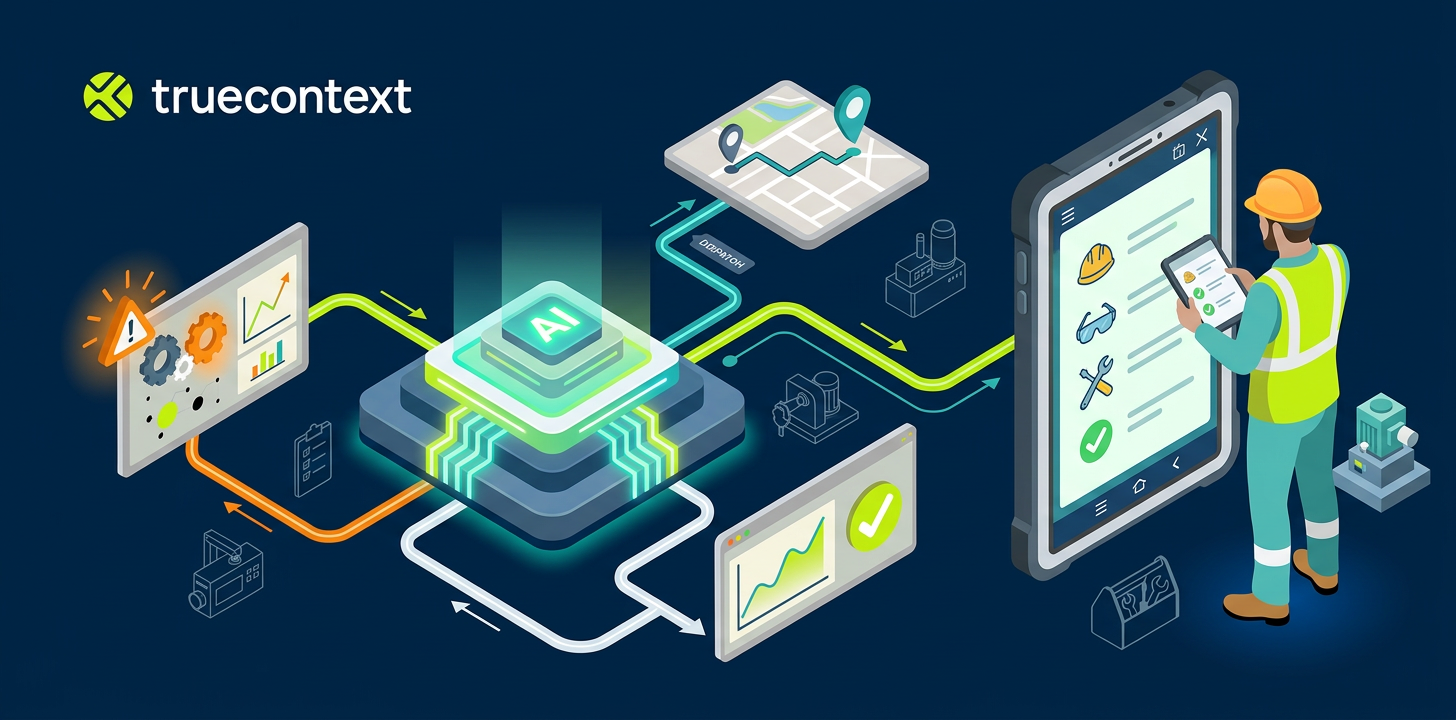
AI-augmented workflows help transform raw field data into predictive insights, automated alerts, and intelligent recommendations. These then flow back to workers in the field, creating a continuous cycle of improvement.
Key takeaways
- AI-augmented workflows combine human expertise with AI-driven analysis, rather than fully automating decisions.
- In field operations, they improve data quality, speed up insights, and reduce manual administrative work.
- Successful workflows rely on structured data capture, system integrations, and human oversight.
- AI insights can trigger automated actions while keeping people in control of critical decisions.
- Platforms like TrueContext enable AI-augmented workflows by connecting field data to analytics and operational systems.
What are the key components of an augmented workflow?
An effective AI-augmented workflow has four interconnected components that work together across field and back-office environments.
Data collection infrastructure
The foundation is the data collection infrastructure. Field workers need tools that capture information consistently and accurately, regardless of connectivity or environmental conditions.
It encompasses simple mobile forms, data validation, and remote operability. Without clean, structured data from the field, AI systems have nothing meaningful to process.
AI processing and analytics
Once they have the data, AI models analyze patterns, detect anomalies, and surface insights that would be difficult to spot manually. This can include trends across inspections, flagging potential risks, or prioritizing follow-up actions based on historical data.
Human oversight and decision-making
AI provides recommendations and insights, but experienced workers determine which actions to take. This human-in-the-loop approach ensures context, relationships, and factors that algorithms can’t fully understand still inform critical decisions.
The goal isn’t to automate human judgment but to give people better information to work with.
Automated actions and feedback loops
Based on AI insights and human decisions, the system triggers appropriate responses. These can be anything, like sending alerts, updating work orders, adjusting schedules, or routing information to relevant stakeholders.
These actions flow back to field workers through their mobile devices, providing them with automated reporting and analytics that inform their next steps. This creates a continuous improvement cycle where each interaction generates data that makes the system smarter over time.
What are the benefits of AI-augmented workflows in field data operations?
AI-augmented workflows deliver measurable benefits across both field execution and operational management.
Increased efficiency
AI can process thousands of data points in seconds, identifying patterns and exceptions that would take humans hours or days to spot manually. Field workers spend less time on paperwork, while managers avoid chasing updates or compiling reports.
Improved data accuracy
AI highlights inconsistencies, missing data, or unusual values in near real time. This improves data quality at the source, reducing downstream errors in reporting or decision-making.
Faster, better decisions
Instead of waiting for weekly reports to identify trends, managers receive real-time alerts about emerging issues. Field workers get immediate access to relevant historical data and AI-powered recommendations right on their mobile devices.
This shortens response times and supports proactive maintenance, safety interventions, or compliance actions.
Improve worker satisfaction and retention
Less talked about, but extremely important, worker satisfaction and retention result from removing tedious tasks and providing tools that make jobs easier. Field workers appreciate technology that helps them do their jobs better rather than simply monitoring their performance.
They spend less time fighting with paperwork and more time solving interesting problems. This improved experience translates directly into lower turnover rates, which is especially valuable given the high cost of recruiting and training field personnel.
Lower operational costs
Cost reduction comes from multiple sources. Reduced rework from errors, optimized resource allocation, predictive maintenance that prevents expensive emergency repairs, and improved first-time fix rates all contribute to lower operational costs.
Organizations also gain better visibility into their operations, identifying inefficiencies that weren’t apparent in traditional manual processes.
How to implement an AI-augmented workflow in field data operations
Successful implementation of AI-augmented workflows requires a strategic approach that considers both technical and organizational factors.
Organizations that rush to deploy AI without proper preparation often struggle to achieve meaningful results. Those that take a methodical approach see faster time to value and higher adoption rates.
The implementation journey typically follows three major phases:
- Establishing a foundation of high-quality data collection.
- Connecting data streams to enable AI processing.
- Closing the loop by delivering insights back to field operations.
Each phase builds on the previous one, creating a system that becomes more valuable as it matures.
You need to start by understanding your organization’s current state. That includes existing workflows, identifying pain points, and defining clear objectives for AI augmentation.
This assessment helps prioritize which workflows to augment first, typically starting with processes that have high volume, clear success metrics, and strong stakeholder support.
Having proven implementation strategies in place significantly increases the likelihood of successful adoption and long-term value realization.
1. Capture structured field data as the foundation for AI
AI systems are only as effective as the data they receive. That’s why structured field data capture is the cornerstone of any AI-augmented workflow.
Mobile forms should standardize inputs such as asset IDs, condition ratings, timestamps, and measurement units.
Field workers need tools that make structured data entry easy rather than burdensome. Modern offline-first mobile forms ensure workers can capture data anywhere, even without cellular connectivity, syncing automatically when connections become available.
Forms should adapt based on context. They should show relevant fields based on previous answers, prepopulate information from other systems, and use intelligent mobile search capabilities. This helps to make data lookup fast and intuitive.
How well teams work together is another important factor, as collaborative field workflows ensure everyone works from the same dataset.
This ultimately reduces duplication and confusion. The result is consistent, high-quality data that AI systems can analyze with confidence.
2. Connect field data streams to your operational and AI systems
Once you’ve captured the data, you need to move it seamlessly across systems. AI-augmented workflows depend on strong integration between field tools, operational platforms, and analytics engines.
Without a reliable data flow, even the most advanced AI models have to work with partial or outdated information.
Using webhooks for real-time data transmission, organizations can push field data instantly into downstream systems, such as asset management, enterprise resource planning (ERP), or AI platforms.
This enables near-real-time analysis and faster operational responses, which is especially critical in environments where delays can impact safety, compliance, or asset uptime.
We also can’t forget about conditional data routing, which ensures the right data reaches the right systems based on context.
For example, safety incidents can be automatically routed to compliance or environment, health, and safety (EHS) teams. At the same time, maintenance observations flow directly into asset management systems for scheduling and follow-up.
This level of automation reduces manual triage and prevents important information from getting lost between teams. Plus, such connectivity eliminates data silos and ensures AI insights are based on complete, up-to-date information.
3. Use AI insights to automate field actions and close the loop
The final step is turning insights into action. AI-augmented workflows don’t stop at analysis. They feed recommendations back into daily operations, ensuring insights actually drive outcomes instead of sitting on dashboards.
AI models can trigger automated alerts, task creation, or workflow updates based on predefined thresholds or detected patterns.
With multidimensional workflow analytics, your team gains visibility into performance trends across assets, locations, or time periods. This makes it easier to prioritize work and allocate resources more effectively.
At the operational level, automated alert generation ensures critical issues reach the right people without manual intervention. Instead of relying on someone to notice a problem after the fact, teams can respond proactively as soon as they identify risks or anomalies.
And most importantly, humans remain in control. They review recommendations, adjust priorities, and apply contextual judgement where needed. This “closed-loop” approach ensures insights continuously improve both field execution and decision-making.
Leverage AI more effectively with TrueContext
TrueContext is designed to support AI-augmented workflows in complex field data environments. The platform enables organizations to capture structured data through flexible mobile workflows, connect that data to enterprise systems, and turn insights into action.
With offline-capable mobile forms, deep integrations, and advanced analytics, TrueContext helps organizations bridge the gap between field execution and AI-driven decision-making.
Rather than adding complexity, it creates a unified workflow where people and AI work together. This improves visibility, efficiency, and operational outcomes.
TrueContext’s approach, which integrates human oversight with real-world data, creates functional, scalable AI-powered workflows that provide immediate value.
