


Key takeaways
- Data helps manufacturers shift from reactive quality control (QC) to proactive, continuous quality improvement.
- Standardized digital workflows ensure consistent, complete data collection at every inspection point.
- Centralizing QC inputs eliminates data silos and provides a single source of truth for investigations and audits.
- Trend analysis and real-time dashboards enable teams to detect anomalies early and prevent defects before they reach customers.
- Closed-loop corrective action processes, powered by reliable data, help manufacturers validate improvements and scale best practices.
- A platform like TrueContext operationalizes QC steps by connecting field data, workflows, analytics, and integrations across the entire organization.
As a manufacturer, you’re probably used to facing a difficult balancing act. You need to deliver higher-quality products, reduce defects, and respond faster to issues, all while handling production lines that are becoming more complex and distributed.
Traditional manufacturing quality control (QC) methods, which rely heavily on manual inspection and after-the-fact reporting, simply can’t keep up.
The solution? Data. When you digitize QC workflows and centralize information from every inspection, measurement, and test, you can transform quality control from a reactive process to a proactive, predictive strategy.
Data-driven decision making in manufacturing operations helps you detect issues earlier and understand why problems are happening and how to prevent them in the future.
So, how can you use data to improve quality control? What does a modern, data-backed QC process look like, and how can the right mobile workflow platform streamline every step? This article will answer all these questions and more.
What is quality control in manufacturing?
Quality control in manufacturing refers to the process and activities used to ensure products meet defined specifications, regulatory requirements, and customer expectations.
It includes inspections, tests, measurements, documentation, and root-cause analysis, all with the goal of preventing defects and ensuring consistent output.
Quality control sits within the broader quality management system (QMS), which includes quality assurance.
Quality assurance focuses on designing processes that prevent errors. By comparison, quality control aims to detect deviations during production and correct them before the product leaves the facility.
Many sectors operate under strict compliance requirements. For this, organizations rely on efficient quality control procedures across regulated industries to show traceability and uphold product safety. QC also plays a critical role in operational outcomes.
How? Accurate inspection data reduces rework, speeds up troubleshooting, and helps maintain service consistency. That’s why many teams now use digital tools.
Tools like quality control inspection software improve first-time fix rates, strengthen documentation, standardize processes, and help identify issues sooner.
But, how does a strong quality management system (QMS) process help you?
- Maintains product reliability and consistency.
- Reduces costly scrap, rework, and returns.
- Improves customer satisfaction and brand reputation.
- Strengthens compliance across regulated industries.
- Identifies process inefficiencies that impact productivity.
What is an example of quality control in manufacturing?
Quality control in manufacturing is not the same regardless of industry or production environment. It can vary quite significantly, and these examples can prove it:
- Incoming materials inspections. Verify that raw materials and components meet specifications before entering the production line.
- In-process inspections. Check dimensions, tolerances, or assembly steps at critical checkpoints to catch defects early.
- Functional testing. Ensure equipment or products operate correctly under specified conditions.
- End-of-line inspection. Review finished goods for defects, performance issues, or aesthetic deviations before shipment.
- Environmental and stress testing. Simulate real-world conditions to validate durability or performance.
In all cases, you’ll need accurate documentation, especially during audits or compliance reviews. Documented quality control checkpoints with audit trails will help you maintain visibility and traceability across every inspection step.
Let’s look at a real-world example. ATC Power Services, an independent operations and maintenance provider for the energy industry, operates facilities in a manner that maximizes production while preserving compliance and ensuring safety. As this is no small task, ACT Power Services entrusted TrueContext to digitize and scale its field data process.
By deploying TrueContext’s flexible, easy-to-use mobile forms and workflows, ACT Power Services expanded to 100+ forms used daily by over 100 technicians. This helps centralize data capture, automate stakeholder reporting, and accelerate overall adoption of new processes.
What are the main responsibilities of quality control?
As a quality control team, you need to make sure every product that leaves the facility meets defined standards. Key responsibilities include:
- Inspections and testing: Verifying that processes, components, and finished goods meet specifications.
- Measurement and data capture: Recording dimensions, tolerances, failures, corrective actions, and environmental conditions.
- Documentation: Maintaining accurate records for audits, compliance, and continuous improvement.
- Monitoring compliance: Ensuring adherence to regulatory requirements, customer-specific standards, and internal policies.
- Identifying non-conformances: Flagging defects or deviations and escalating them for corrective action.
- Root-cause analysis: Investigating why issues occurred and recommending changes to prevent recurrence.
- Collaboration: Working with production, engineering, and maintenance teams to address emerging issues.
How to establish a data-backed quality control process in manufacturing
Digitizing and centralizing QC workflows allows manufacturers to move beyond clipboards and spreadsheets. A data-backed approach provides complete visibility, faster investigation, and the ability to spot trends manual methods simply can’t detect.
Here’s a practical framework for building a modern QC program grounded in accurate, accessible data.
Standardize quality data collection with structured mobile workflows
When you build a QC program, you need complete, correct data. That’s the foundation, without which no such program will truly work. But, manual processes run into several issues like:
- Incomplete forms.
- Misread measurements.
- Delayed reporting.
- Difficulty comparing results across teams, shifts or facilities.
On top of that, you’ll sometimes walk into network-limited environments. When that happens, you need to use mobile quality control forms that work offline.
The best solution to these problems is a structured digital workflow. It helps by guiding technicians step by step through their inspections.
Mobile forms can enforce data requirements; standardize measurement fields; and capture photos, barcodes, timestamps, and geolocation automatically.
This approach ensures one important thing: that every inspector captures information the same way, thus improving accuracy and reducing variability.
Centralize all QC inputs into a single source of truth
A common struggle you’ll often run into is fragmented QC data. You’ll find some of it in a mix of spreadsheets, emails, and disconnected systems. This makes it nearly impossible to perform efficient investigations, compare results across sites, or build reliable reports.
A centralized QC data hub can consolidate inspection records, test results, images and annotated evidence, environmental or machine-generated data, and non-conformance results.
It allows teams to track trends across products, shifts, equipment, or facilities. Plus, a centralized QC data hub ensures stakeholders always have access to the latest information.
TrueContext integrates QC data into existing systems, including Salesforce and ServiceNow. This supports your enterprise and ensures QC managers, engineering, and leadership work from a unified data source.
Use built-in analytics and trend monitoring to detect issues early
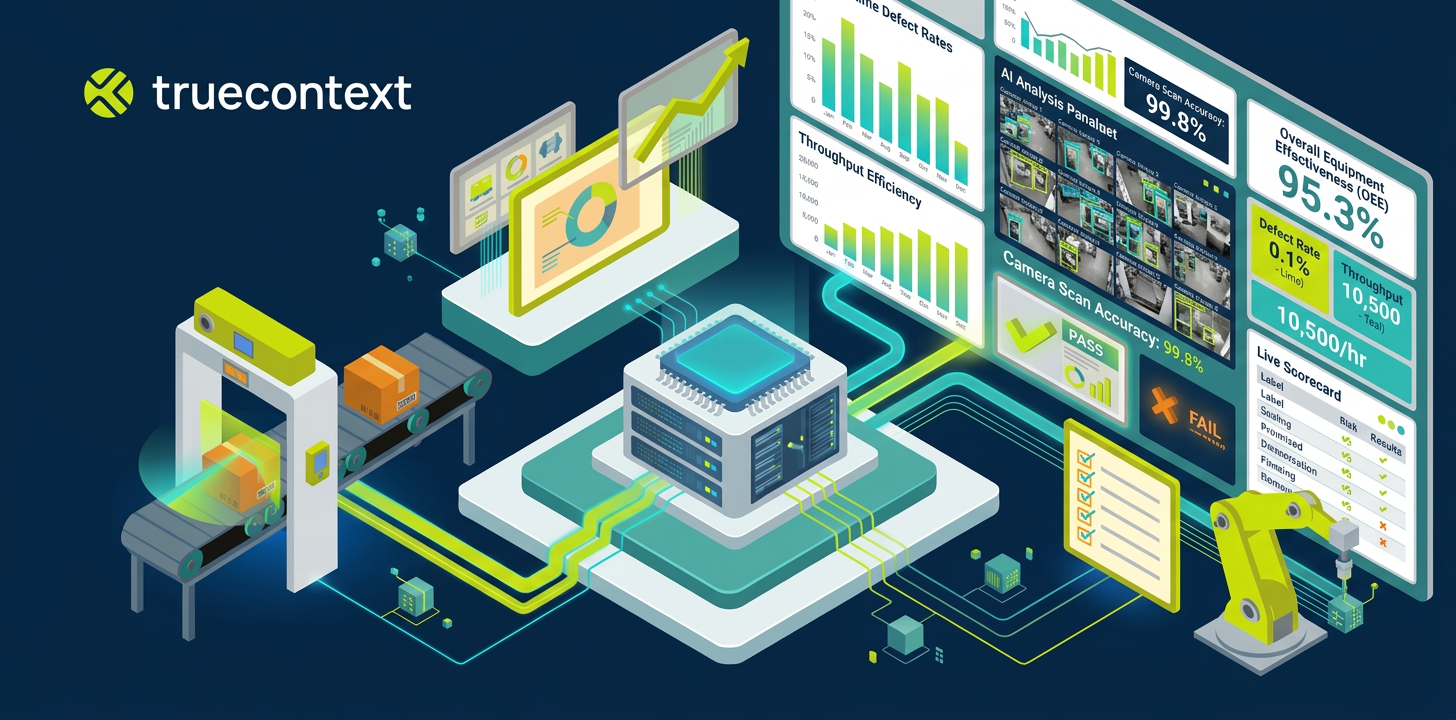
After you digitize and centralize your QC data, analytics become a powerful tool for finding patterns and predicting potential failures. Real-time dashboards can reveal:
- Rising defect rates on specific lines.
- Recurring issues tied to certain materials or suppliers.
- Shifts or sites with statistically significant variations.
- Out-of-spec measurements before they trigger full defects.
- Seasonal or environmental factors influencing product quality.
Detecting these signals early allows manufacturers to respond before issues escalate, reducing downtime and preventing bad batches from moving downstream.
Platforms that provide enterprise-grade analytics for quality trend monitoring and surface insights through real-time quality dashboards make it easier to spot anomalies and fix them quickly.
Create a closed-loop corrective action and continuous improvement cycle
A good QC program doesn’t end once it detects issues. The real value comes from using data to improve processes continuously. A closed-loop corrective action cycle typically includes:
- Issue identification: Detecting anomalies or non-conformances.
- Root-cause investigation: Using data from inspections, equipment logs, and operator input.
- Corrective action: Implementing changes, repairs, retraining, or process adjustments.
- Verification: Confirming the corrective action actually resolved the issue.
- Continuous improvement: Using lessons learned to refine workflows and reduce future risks.
Digital workflows make this closed loop a lot easier. They document every step, track ownership, and ensure accountability.
That’s why many organizations rely on collaborative corrective action workflows to coordinate tasks across teams, improve communication, and resolve issues quicker.
Move beyond simple inspection with TrueContext
If you want real-time visibility, cross-team coordination, and automation, you need to prioritize quality control in manufacturing.
With things like comprehensive submission analytics, you can gain a complete view of inspection data and quality trends. This will allow you to make faster decisions and have a more proactive approach to issue detection.
TrueContext can give you all of that and more, through:
- Low-code mobile workflows that standardize inspections and ensure complete, consistent data capture.
- Offline-first capabilities to support technicians anywhere, from plant floors to remote production sites.
- Integrations with enterprise systems like Salesforce, ServiceNow, and Microsoft, ensuring QC data flows seamlessly across the organization.
- Robust analytics dashboards that help teams monitor trends, detect deviations early, and make evidence-based decisions.
- Closed-loop corrective action workflows that help resolve issues efficiently and continuously validate improvements.
With TrueContext, you can turn quality control from a reactive function to one that is proactive, integrated, and continuous. This kind of QC process strengthens product consistency, reduces downtime, and improves customer satisfaction.
