



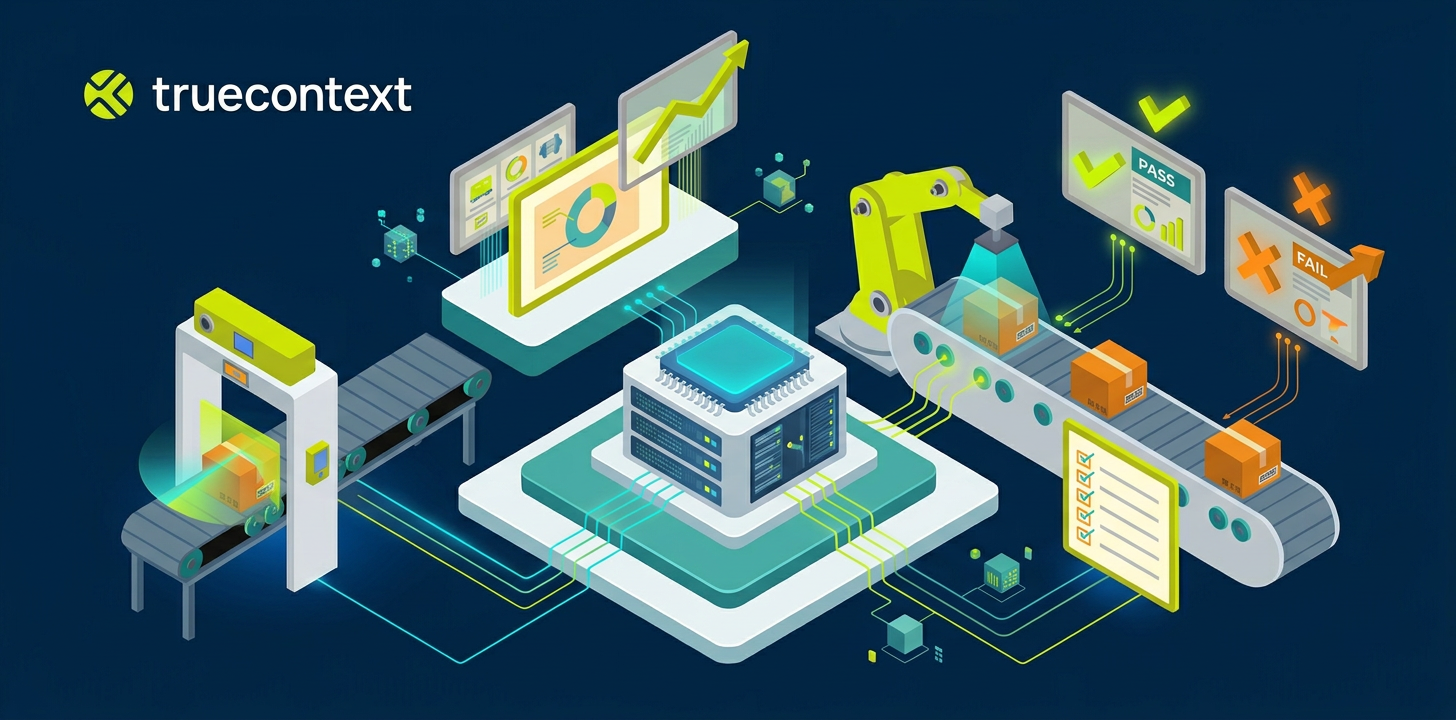
As a manufacturer, you’re under immense pressure to improve product quality while maintaining throughput, controlling costs, and meeting stricter regulatory requirements.
There are many traditional quality control methods to help, such as manual inspections, static rules, and isolated automation. But, they struggle to keep up with the scale and complexity of modern production environments.
That’s where AI for manufacturing quality control (QC) comes in. When implemented correctly, AI enables faster inspections, more consistent defect detection, and earlier intervention before quality issues escalate into recalls or rework.
This article will outline best practices for implementing AI in manufacturing quality control, from preparing your workflows and data foundation to automating responses and building predictive quality models.
Key takeaways
- AI improves manufacturing quality control by detecting defects and anomalies faster and more consistently than manual inspection methods.
- Successful AI adoption depends on digitized, standardized quality control workflows.
- Integrating AI inspection data into a centralized system prevents data silos and improves traceability.
- Automated responses reduce defect escape rates by closing the gap between detection and action.
- Historical inspection data can be used to build predictive quality models that prevent future issues.
The role of AI in manufacturing quality control
AI is changing the way people approach quality control in manufacturing by augmenting and, in some cases, replacing traditional inspection processes.
Instead of relying solely on manual checks or rule-based automation, AI systems analyze large volumes of inspection data. This helps QC teams to identify patterns, anomalies, and defects in real time.
Common AI applications in quality control for manufacturers include:
- Visual inspection using computer vision to identify surface defects or dimensional issues.
- Anomaly detection that flags deviations from normal production behavior.
- Pattern recognition across batches, shifts, or production lines.
Unlike traditional automated systems that follow predefined rules, AI models continuously learn from new data. This allows them to adapt to process variations, identify subtle defects, and reduce false positives over time.
When paired with mobile data capture and digital inspections, quality control inspection software enhances consistency and reduces defects. It ensures inspection data is complete, standardized, and immediately available for analysis.
What are the tangible benefits of AI in manufacturing quality control?
AI in manufacturing quality control is more effective and more precise. But, its efficiency is best measured in operational and financial outcomes. If you implement AI-driven inspection processes, you’ll typically see improvements across several key metrics.
- Reduced defect rates. AI systems detect defects earlier and more consistently than manual inspections, reducing the number of nonconforming products that move downstream.
- Faster inspection cycles. Automated inspection and analysis significantly shorten inspection times, allowing quality checks to keep pace with high-speed production lines.
- Lower labor and rework costs. By reducing manual inspection effort and catching issues before rework is required, AI lowers operational costs and improves productivity.
- Improved consistency and auditability. AI applies the same inspection criteria every time, eliminating variability caused by human judgment and fatigue.
- Fewer recalls and customer complaints. Early detection and faster response reduce the likelihood of defects reaching customers, protecting brand reputation.
These improvements also support downstream service and maintenance workflows, including improving first-time fix rates by ensuring products meet quality standards before deployment.
How to implement AI in manufacturing quality control
Successful AI implementation in quality control doesn’t mean just purchasing technology and flipping a switch. It requires a strategic, phased approach that builds capabilities systematically.
Deploying AI across all quality control simultaneously is a mistake that can often lead to integration challenges, user resistance, and disappointing results.
The most effective implementations follow a sequential strategy:
- Establish the digital foundation.
- Integrate data systems.
- Automate responses.
- Leverage accumulated data for predictive capabilities.
This progression allows you to learn, adjust, and show value at each stage before moving forward to the next level of sophistication.
Digitize and standardize QC workflows before adding AI
AI systems require clean, consistent, structured data to function effectively. Attempting to overlay AI onto paper-based processes or inconsistent digital workflows is like building a house on an unstable foundation. The entire structure becomes compromised.
Before introducing AI, manufacturers must first transition from paper inspection checklists, spreadsheets, and disconnected systems to unified digital workflows.
Establishing digital quality control procedures means:
- Defining exactly how to conduct inspections.
- What criteria constitute pass or fail.
- How to document results.
This standardization eliminates the variability that occurs when different inspectors interpret requirements differently or when procedures differ between shifts or locations.
Digitizing and standardizing workflows creates the structured data environment that AI needs. When every inspection follows the same digital process and captures data in the same format, AI algorithms can analyze patterns, identify trends, and make accurate predictions.
Without this foundation, AI systems receive inconsistent inputs that undermine their analytical capabilities and produce unreliable outputs.
This preparation phase also builds organizational readiness. Workers become comfortable with digital tools and structured processes before encountering AI, reducing change management challenges later. Quality managers develop the data literacy needed to interpret AI insights effectively.
Integrate AI inspection data into a single source of truth
AI inspection systems generate vast amounts of data: images, measurements, classifications, and anomaly scores. This data holds immense value, but only if it’s accessible and contextualized alongside other manufacturing information.
When AI inspection data remains isolated in standalone systems, manufacturers miss opportunities for comprehensive analysis.
Consolidating AI-generated insights with production data, maintenance records, material traceability, and process parameters creates a complete picture of quality performance.
This integration enables manufacturers to answer critical questions:
- Do quality issues correlate with specific material batches?
- Does equipment performance deteriorate before defect rates increase?
- Are certain production shifts or operators associated with quality variations?
Connecting field operations with back-office systems ensures quality insights reach the people who need them.
Production supervisors see real-time quality metrics. Engineers access historical defect patterns for root cause analysis. Supply chain teams receive alerts about material quality issues. Customer service can trace product histories when investigating field failures.
Streamlining data flow between systems eliminates manual data transfer, reduces errors, and speeds up decision-making.
When AI detects a quality issue, that information immediately becomes available across all relevant systems. No delays for data entry, no risk of transcription errors, no information silos preventing effective response.
A single source of truth also supports regulatory compliance and audit requirements. Manufacturers can demonstrate complete traceability, showing exactly when products were inspected, what AI systems found, and what actions were taken in response.
Automate QC responses to reduce defect escape
AI’s speed advantage only translates to business value when detection triggers immediate action.
A system that identifies defects but requires human intervention to respond still allows defective products to continue through production. That is until someone notices the alert and takes action. This delay creates defect escape opportunities.
Automated workflows with triggered actions close this gap. They immediately execute predefined responses when AI detects quality issues. These workflows might:
- Automatically stop production lines, preventing additional defective units from being manufactured.
- Quarantine suspect products, ensuring they don’t mix with good inventory.
- Notify quality engineers, maintenance teams, or production supervisors instantly, specifying the issue type and location.
More sophisticated automation can start corrective action workflows. When AI identifies a specific defect pattern, the system can automatically create a corrective action request.
It’ll then assign it to the responsible engineer, set a deadline, and track completion. The AI can even adjust process parameters within acceptable ranges to compensate for drift detected by AI inspection.
Real-time automated responses minimize the time between detection and correction, which directly reduces defect escape rates.
In high-speed manufacturing environments, every second matters. Automated response transforms AI from a monitoring tool into an active quality control participant that protects product integrity continuously.
These automated responses should be configurable based on defect severity. Minor anomalies might generate data for analysis without disrupting production, while critical defects trigger immediate line stops. This tiered approach balances quality protection with operational efficiency.
Use inspection data to train predictive quality models
The ultimate value of AI in quality control extends beyond detecting existing defects to predicting future quality issues before they occur.
As AI inspection systems accumulate historical data, manufacturers can analyze patterns that precede quality problems. They can then build predictive models that enable proactive intervention.
These predictive capabilities shift quality control from reactive to proactive. Instead of finding defects after they occur, manufacturers can identify conditions that lead to defects. This allows them to address the issues preemptively.
Historical data might reveal:
- Specific equipment sensors show characteristic patterns before producing defective parts.
- Certain combinations of material properties and environmental conditions correlate with increased defect rates.
- Process parameter drift precedes quality degradation by measurable intervals.
Leveraging inspection data for predictive maintenance scheduling represents a powerful application.
When AI inspection data shows gradual degradation in product quality from specific equipment, predictive models can schedule maintenance before defect rates increase significantly. This proactive approach prevents quality issues while optimizing maintenance resource allocation.
Predictive models also inform process optimization. Manufacturers can enhance their performance by identifying the process parameters that significantly affect quality outcomes. Before making changes to the production process, they can test the potential impact on quality through simulations.
Use AI more effectively with TrueContext
TrueContext provides the platform capabilities manufacturers need to operationalize AI-driven quality control best practices. Its low-code workflow capabilities enable teams to digitize inspections, standardize processes, and collect high-quality data at the source.
TrueContext brings together quality data, automates actions, and gives manufacturers real-time insights across their operations by combining AI inspection results with their existing systems. Built-in automation ensures AI insights translate into immediate action, while analytics tools support predictive quality initiatives.
TrueContext is built for manufacturers, including those operating in regulated environments such as AI software for medical device manufacturing quality control. It offers workflow digitization, system integration, and automation in a single platform that supports scalable, data-driven quality control.
