



There’s a version of this problem that every field service leader knows. You have one technician who can walk into an unfamiliar job, read the situation instantly, know exactly what’s wrong, and resolve it the first time. They’ve seen it all before — what a tricky failure looks like, what asset manuals don’t say, and how to solve the problem without digging up old files or calling HQ. When they leave for the day, all of that knowledge leaves with them.
The 2026 State of Field Service report confirms how widespread this problem is becoming. Forty-five percent of senior field service leaders cite workforce capacity constraints and technician shortage as a top barrier to growth. Another 34% flag insufficient digital readiness among field technicians as a challenge to realizing value from technology investments. They seem disconnected, but they’re symptoms of the same root cause: expertise that lives in individuals, not in systems.
The Cost of Concentrated Knowledge
When institutional knowledge isn’t systematically captured and distributed, every new hire starts from scratch rather than from an acceptable competence baseline. Each retirement or departure takes expertise with it. Senior technicians spend disproportionate time answering questions from junior colleagues rather than working on the jobs only they can handle. When they’re not available, the whole operation comes to a halt.
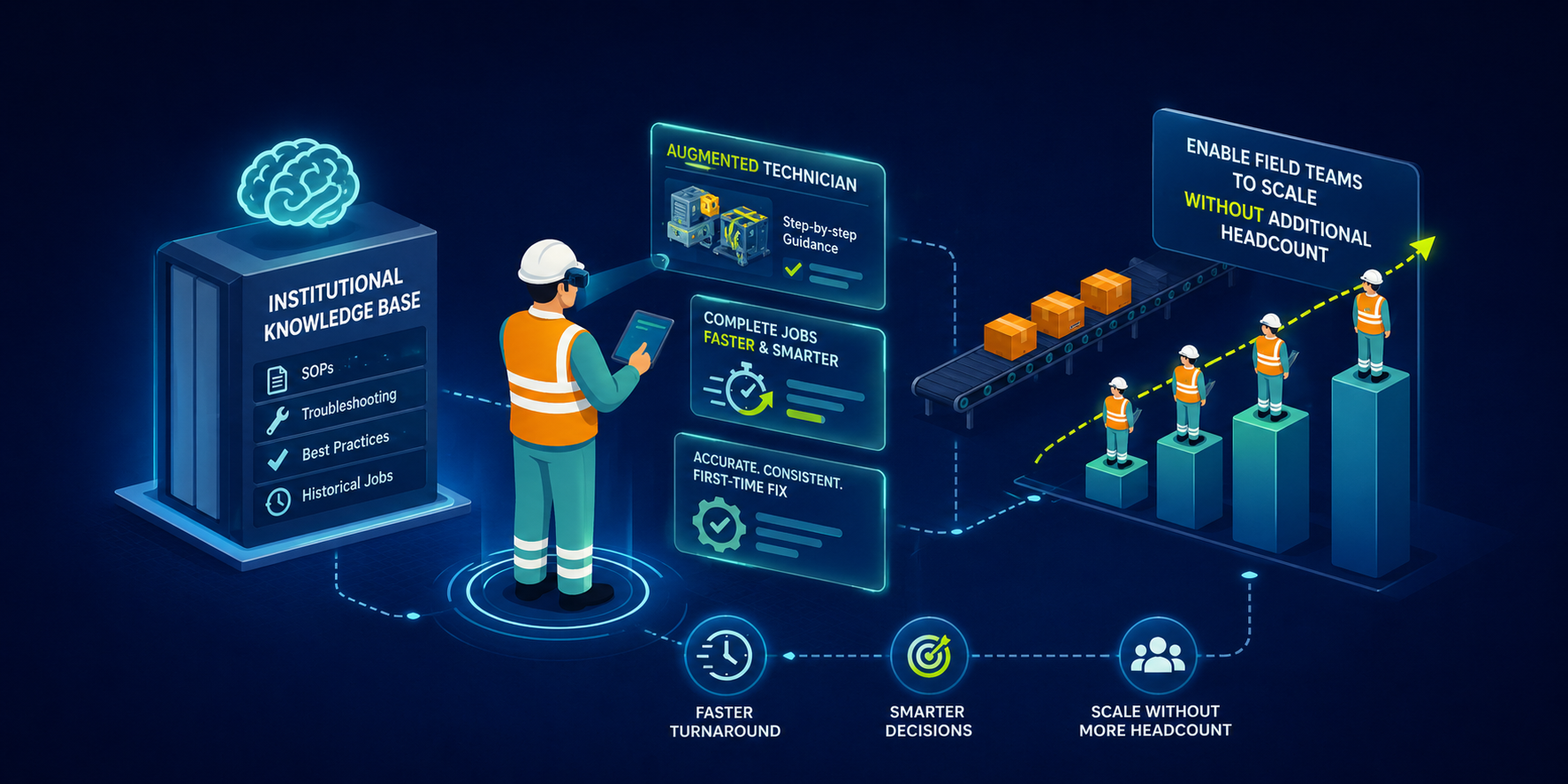
This is the context behind the Augmented Technician concept. Instead of replacing technicians, the goal is to make what they know available to everyone on the team, at the moment it’s actually needed. It’s surfacing what comes out of a training manual or a comprehensive knowledge base, contextualized and applied to a given service event — when a technician is standing in front of the asset.
45% of field service leaders cite workforce capacity constraints and technician shortage as a top barrier to growth.

Discover more field service industry insights.
Download our State of Field Service 2026 Report, developed in partnership with Field Service Next.
The Preparation Problem
In any industry, there is always the underestimated cost of preparation and field service is no different. When technicians arrive at a job without the necessary context — prior service notes, asset history, or documentation relevant to what they’re likely to encounter — they spend the first portion of every job figuring out what the job actually is rather than doing it. That results in a staggering waste when scaled across hundreds or thousands of jobs.
Orgs that systematically reduce prep friction see productivity improvements in the range of 10 to 15 percent, which, in field ops, makes the difference between incurring additional costs for headcount and being able to grow service capacity with your existing team. It translates directly to better first-time fix rates, fewer repeat visits, and lower administrative overhead.
The report corroborates this at a structural level. The organizations seeing the most value from technology are the ones that treated execution quality as the first objective — not the ones that deployed the most tools.
They already have a good idea of what they’re walking into, so when they do, the job starts faster, the problem is diagnosed more quickly, and the solution they execute actually fixes the problem.
What Augmentation Actually Looks Like in Field Service
Work History and On-Demand Integrations are some of the most direct applications of this principle. Work History surfaces prior service records, asset trends, previous job notes, and relevant historical data directly inside the technician’s active workflow. On-Demand Data Sources and Webhooks pull real-time data from enterprise integrations mid-workflow, so your teams stay focused on the job, not the hunt for information.
A technician arriving at a job sees what happened the last three times someone serviced that asset. They see what was replaced, what was noted as a potential issue, what workaround was used when the standard procedure didn’t apply. They already have a good idea of what they’re walking into, so when they do, the job starts faster, the problem is diagnosed more quickly, and the solution they execute actually fixes the problem.
For newer technicians, this is transformative. Rather than starting from zero, they’re starting from an ideal position that incorporates and applies everything the organization has learned about that asset, that customer, and that class of problem. And yet, this is still valuable even for experienced technicians. Fewer things fall through the cracks, while their own expertise gets contributed back into the system so the next technician benefits from it.
Scaling Without Headcount
The workforce capacity problem isn’t going away. Technician shortages have become a structural challenge instead of a cyclical one. Hence, the organizations that solve this problem won’t do it by outcompeting each other for the same shrinking pool of experienced talent. They’ll do it by building systems that make their existing teams more capable and by ensuring that when experienced technicians eventually leave, their knowledge stays.
Every job completed in TrueContext is a contribution to the organizational knowledge base. Every structured note, every photo, every resolved issue adds to the history that makes the next job smarter. And that base compounds with each form submitted. The team that starts today with thirty technicians and TrueContext has access to more institutional knowledge in two years than a team of fifty who capture nothing.
Your best technician is an asset. The goal is to make them the foundation, not the ceiling.
